Give Me 15 Minutes & I’ll Show You How to Turn a 29-Point Deficit into a 2026 Championship Win
Jun 18, 2026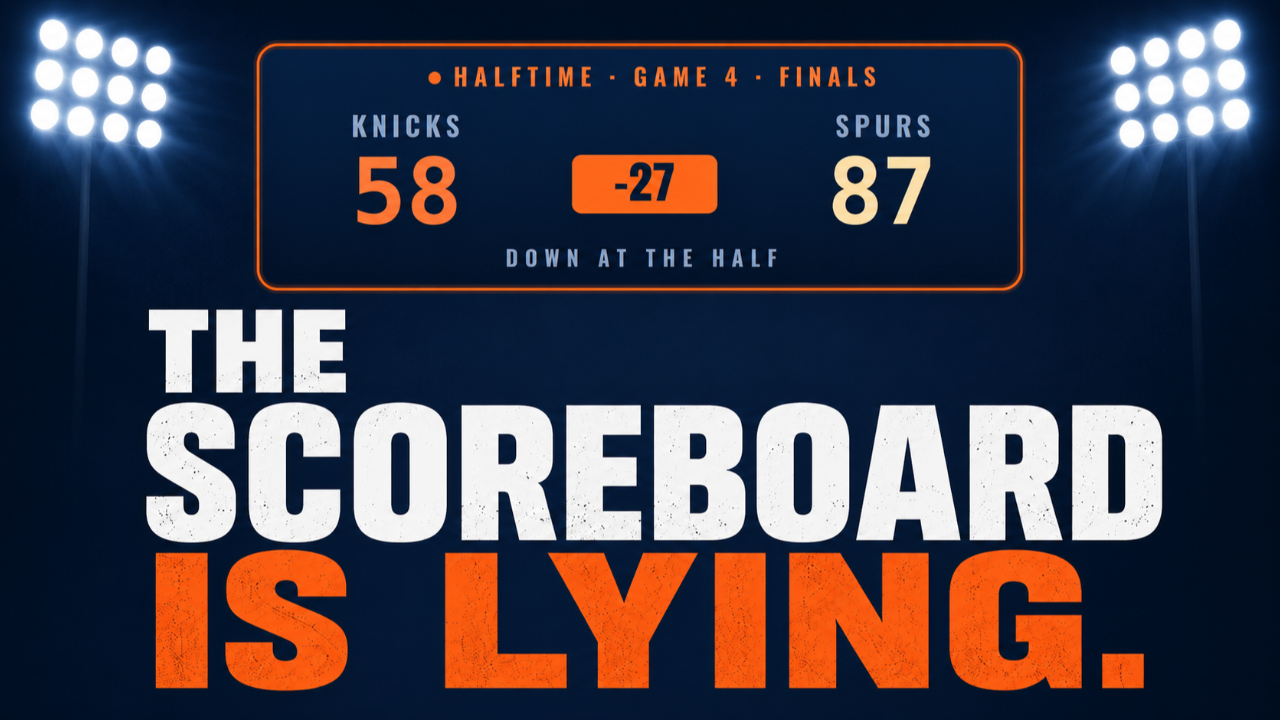
It's halftime of your business year. Six months down, six to go.
So here's the only question that matters this week: based on the first half, are you the Spurs or the Knicks?
If you watched any of the NBA Finals, you already know why that question isn't rhetorical.
Imagine you’re on the road, the season is on the line, and you’re facing a Spurs team that has dominated every minute. Now, picture the scoreboard: you’re down 29 points (27 at the half). By every reasonable measure, it’s over.
In Game 4, the Knicks were down 29 — the largest deficit any team has ever erased in Finals history.
They won. And three nights later they were champions for the first time in 53 years.
So before you write off your own first six months — or quietly assume your lead is safe — I want you to sit with this question: Is your current "score" a permanent reality or just a halftime report?
Your business could be either team
You could be up 29. Coasting, comfortable, assuming the lead holds and that what you did the front half is sustainable and/or will keep getting you the results.
You could be down 29. Behind on revenue, behind on pipeline, telling yourself the year is basically decided.
You’ve probably noticed that little voice in your head saying, "It's too late to catch up now," right? Or maybe it's whispering, "You’ve already won, you can afford to take your foot off the gas."
Halftime doesn't care. The final score almost never looks like the halftime score. What happens next is up to you.
The part most people skip
Here's where most second-half plans die before they start.
A great strategy won't save you if the story you're telling yourself is "I'm too far behind." You might find yourself building the perfect comeback plan but never actually running it, because you’ve already decided how the year ends. I know this because I’ve been there—but more importantly, you need to realize that your belief is the only thing that dictates your next play.
You can't out-strategy a story you don't believe. So you fix the story first.
Mindset, then strategy, then action. In that order. Always.
The Knicks didn't come back because they drew up a better play at the break. They came back because, down 29, not one of them believed the game was over. The belief came first. The buckets followed.
Your 15-minute halftime
Grab a piece of paper and somewhere quiet. Draw a line down the middle and one across — four boxes.
- Wins. What went right in the first half? Name them, even the small ones.
- What the wins taught you. The lesson matters more than the win. What made it work — and how do you do it on purpose again?
- What didn't go well. The misses, the things that blew up, the stuff that ate your time and energy. Be honest.
- What those misses taught you. This is the most valuable box on the page. Your losses are holding the keys to your second-half wins. Identify what you’ve learned and decide how you want to apply the lessons to the back half of the year.
How would it feel to walk into July with a pipeline that is heating up instead of cooling down?
Then zero in on one area: how you brought in business.
What worked in your sales and prospecting over the last six months…the outreach that landed, the conversations that converted, the referrals you asked for? And what didn't…the follow-ups that slid, the pipeline you let go cold, the stretch where you got buried in delivery and quietly stopped selling?
Name both. For most founders, the entire second-half comeback lives right there.
Then look forward
Two questions to close it out:
- What are the one or two moves that, if you made them now, would genuinely change how this year ends?
- Who do you need to pull into your world — someone a step ahead of you, a contractor who clears your plate, the partnership you keep dreaming about but haven't acted on?
If you believed your year is made in the second half, what is the very first move you would make tomorrow morning?
So — Spurs or Knicks?
At the halftime whistle, which one are you right now? The honest version, not the LinkedIn version.
Whatever your deficit is, it's smaller than 29. And there's a lot of game left.
There's still plenty of time to Win Your Way.