
Blog
The $899 bee sting

Theo got stung by a bee last week. Right near his eye.
He’s five months old — my first puppy — so I did what any first-time puppy parent does: I called the vet. They didn’t hesitate. “Bring him in immediately.”
His eye was swollen. But he was acting completely like Theo. Tail wagging, sniffing around the car. By the time we got to the clinic, I could have sworn the swelling was already going down.
In the lobby, a technician ran through a list of questions, told me they wanted to keep him for observation, and handed me a form asking whether I wanted them to resuscitate him if something went wrong.
For a bee sting.
Then came the itemized estimate: $899.
What I did in the lobby
I understand bees can cause allergic reactions. I also understood that an hour in, my puppy wasn’t showing a single symptom of one. No trouble breathing, no hives, no lethargy. If anything, the swelling looked better than when we walked in.
So while I waited for the vet, I went through the estimate line by ...
Two doctors. Same 45 minutes. Completely different experience.
Last week I had two doctor's appointments, back-to-back.
Each visit ran about 45 minutes. Both moved me through efficiently. I walked out of both feeling fine.
And I had two completely different experiences.
The first appointment
I checked in. I barely sat in the waiting room. Everyone who touched my visit was pleasant, and each one told me what was happening next.
I had ample time with my doctor. She asked me — more than once — what other questions I had. She explained things in detail I understood; she was relatable. She answered all my questions, never appeared time crunched, though I imagine she was. As she left, she told me what would happen next.
Nothing sat idle. I was never waiting more than a minute or two, start to finish.
The second appointment
Checked in efficiently. Then I waited, well past my appointment time, before someone brought me into a room, only to move me to a second waiting room, until a room finally opened up…to wait.
The doctor spent maybe two minutes...
The Fastest Way I Grew This Business? Letting Go.

The first three years of this business, I said yes to everything.
Executive leadership retreats. Building out sales leadership teams. Business consulting for owners across half a dozen industries. I loved a lot of it — until I didn't. Somewhere in year three, I looked up and realized I'd become the exact thing I now warn founders about: the overbooked expert, juggling so many topics and client types that “growth” had quietly become exhaustion wearing a nicer name.
I see this constantly in people who left corporate to build something of their own. You can do a lot of things well. That's exactly the trap.
What the 42 Dive taught me about my own business
Way before any of this, I was a sportscaster covering the NDSU Bison — a program that won national championship after national championship on the back of a core play, run over and over: the 42 Dive. Three yards, time and time again. Not flashy. But run consistently enough, against a defense forced to respect it, and it's what ...
The client who let me have it

Somewhere along the way, someone handed you a definition of winning.
You probably didn't notice it happening. A parent. A first boss. A leaderboard on the wall. A number someone else set that you agreed to carry.
And you've been running on it ever since.
Here's what I want to hand you today: you can keep it, or you can choose your own.
That's the whole decision.
Change is not something that happens to you
We talk about change like weather. The market changed. My biggest client changed. The referrals dried up.
Some of that is true. Conditions shift and you don't get a vote.
But the change that moves your business isn't the one that arrives. It's the one you choose — usually quietly, usually without an announcement, usually on an ordinary Tuesday when you decide you're not doing it the old way anymore.
Change is a decision. Not an event.
I spent years competing against yesterday's me
My sales career started in an environment that was flat out win-lose. Monthly rankings. Monthl...
What Would You Subtract?
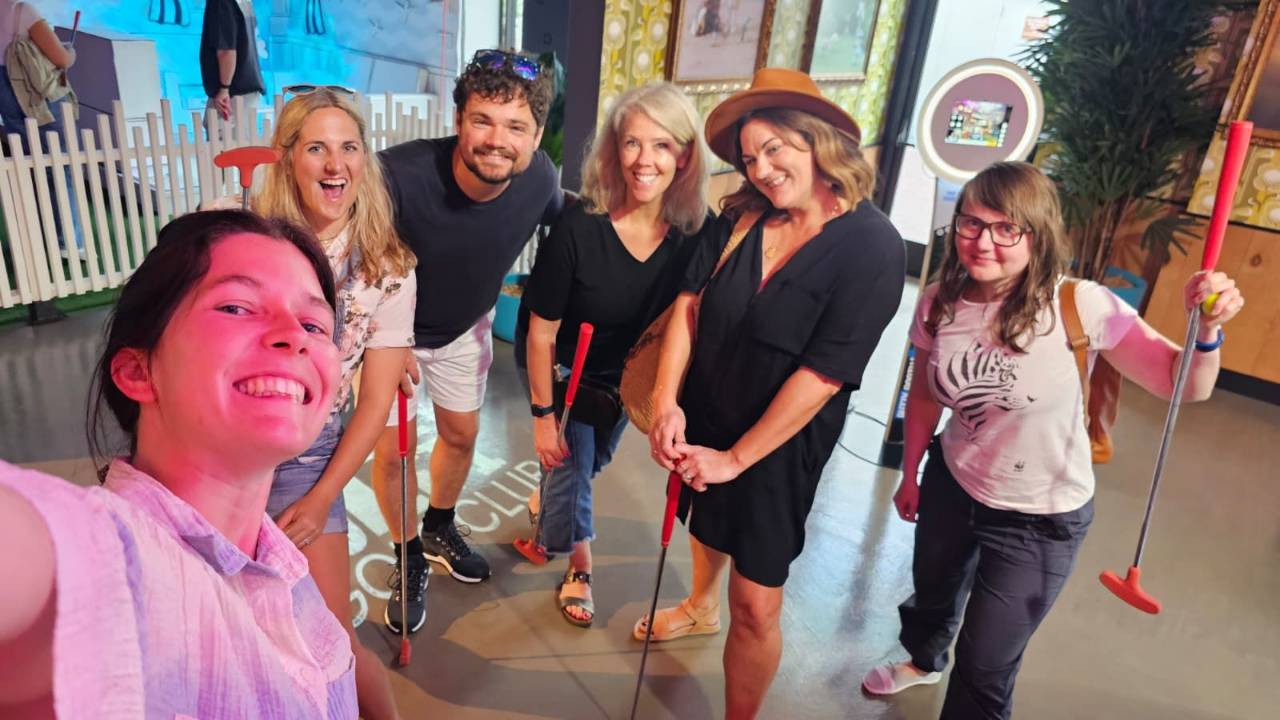
I did something last week I’m pretty sure I’ve never done in my life.
I stayed for the whole thing.
Five days at a mastermind retreat with other business owners. No slipping out early. No catching the last flight home. No “I’ll just come for the two main days.”
And it was the most energizing, didn’t-know-I-needed-it week I’ve had in eight years of running this business.
The question I’d been carrying for years
I’ve invested in personal growth for decades. It probably started when my father handed me Tony Robbins and Brian Tracy sales tapes in high school. Every year since, I pick one program, one room, one thing I’m going to participate in for the year.
But something was missing, and I wonder if you’ve felt this too:
Where are my people?
Not a networking group. Not an audience. Something else — and it took me three years of looking to be able to name what I was really seeking. More on that in a minute, because it turned into a test I now run on every room I consider joining.
W...
Expressing Explicit Expectations

You said it. You know you said it. You could point to the exact conversation.
And the thing you asked for still came back not quite right.
So you fixed it yourself. Again. On a Saturday.
Here's what I've watched happen over and over this past month, with solo founders, with founders running a small but mighty teams, with founders whose whole operation is two contractors and a VA in a different time zone: the expectation is fully formed. It's just fully formed in your head.
You're not unclear. You're under-expressed. And those cost you the same amount of money.
I call the fix Expressing Explicit Expectations. Three words, three moves, and most of us have opportunity in all three moves. Let’s break it down:
Expectations: you have them, even when you say you don't
You have high expectations of yourself, for sure, and often of those around you. Yet when I ask founders what they expect, I usually hear a version of: "Honestly, my expectations are pretty low." Or "I'm not sure what to expect when th...
The morning I almost cried before an offsite

It was 7:00 AM. The client’s leadership team offsite started at 8:30. My slides for the day weren’t finished, and I was sitting there nearly in tears.
How did I get here?
It wasn’t for lack of caring. I had spent an incredible amount of time preparing — thinking about this team, what they were up against, what would help them have a breakthrough. And there I was, having a breakdown ninety minutes before I was supposed to spend an entire day with them.
How had I gotten to the point where I couldn’t focus on how I was going to show up and deliver my best for a team that deserved my best?
I’d love to tell you that was a one-time thing. It wasn’t. There was a stretch in my business where that morning kept repeating itself. Say yes to the opportunity. Customize everything from scratch, on a variety of business needs. Deliver it. Walk away knowing I could have done it better.
That was my referral-dependent stage. Sell it, then figure out how to build it.
The business grew exponentially. And it cos...
Referrals got you here. They won't get you there.

"Sarah" was booked solid and struggling to make payroll.
She runs a business consulting firm — about $2 million a year, six people. Every piece of business came through a referral or an introduction, and she was proud of that. She'd never had to "sell" a day in her life.
She was also exhausted, and the money didn't match the effort.
So we listed everything she was delivering. Nine different services. Nine.
When I asked which she had chosen to offer, the honest answer was almost none. Every one had arrived the same way: someone she trusted sent someone over, that person needed something adjacent to her real work, and she said yes because she could.
She wasn't running a business. She was running a response system.
We cut nine services to three, aimed at one buyer: the CEO of a mid-cap company carrying a leadership team problem. Everything else went — including revenue she was nervous to let go of.
Nine months later the firm was at nearly $3.8 million.
Referrals are the floor, not the ceiling
Let'...
Which of These Five Founder Identities Are You?

A few weeks ago I told you there were five distinct sales identities most founders operate from — and then I left you hanging. “More on that another week,” I said.
This is the week.
But fair warning before we start: four of these five are the same problem wearing four different disguises. See if you can spot yours.
Back in a previous post we talked about how identity is the real ceiling — that you can hand a reluctant seller the perfect script and they'll still find a way not to use it, because tactics live downstream of who you believe you are. These five identities are what that looks like up close. Which one you're running explains almost everything about where you get stuck.
Here they are.
- The Referral Rider. Your growth depends entirely on other people sending you work. You might be sitting there thinking, "But a referral-only business is the ultimate proof of quality!" And if that's you, YES! I agree, relying on word-of-mouth means you do incredible work. And... it also m ...
You Don't Have To Be The Whole Solution

Early in my career, I thought my job was to be the whole solution. Beat the other reps, win the deal, be the hero.
It made selling exhausting. And it kept me stuck in a game I didn't even want to play.
Here's what changed everything: I realized I didn't have to be the whole solution. I just had to be the right piece of it.
That one shift is freeing. When you move out of vendor mode and into partner mode, you're no longer fighting to prove you're better than everyone else. Instead, you get to help someone see the whole picture and show them exactly where you fit into it. When a client believes you understand where they are, where they want to go, and that what you offer helps them get there, you've created something a pitch never could: an invitation.
Because sales is not an event. It's a natural progression that leads to an invitation for someone to experience a different outcome.
I learned the transactional sale early, first as an 8-year-old selling Girl Scout cookies door to doo...

Click the button below if you would like a chance to be featured on the Champions of RISK Podcast.

Recent Posts
